
Over the weekend I asked Google’s Gemini to make a simple 10 x 10 times table for my son. The first version came back as plain text, and every number was right. Then I asked for something I could print, and it gave me a colourful poster with cartoon pencils, an owl in the corner and a tips section at the bottom. It looked like something you’d buy at a teacher supply website.
Then I noticed that 2 x 2 was 3.
When I went through the whole chart, almost half the answers were wrong. 2 x 3 was 5, 7 x 6 was 55, 9 x 9 was 88, and the tips section spelled “multiples” as “multyplies”. Here’s the chart Gemini gave me, with every wrong answer circled.
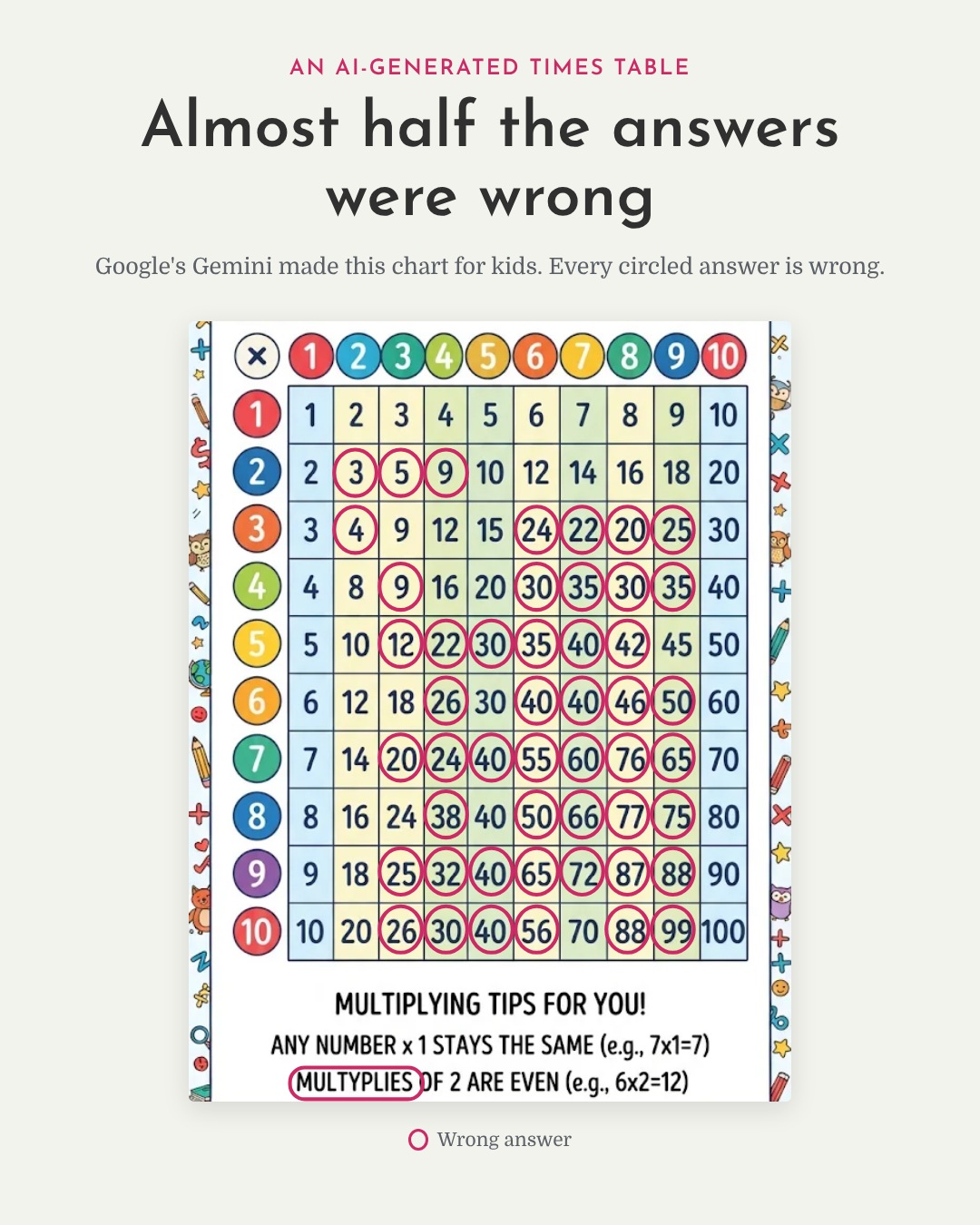
I know a story like this could look made up, coming from someone who does this work for a living. I’m not against AI, and you can see the full conversation with Gemini here, including the original image.
When I pointed out the mistake, Gemini agreed right away and explained that image generators often have trouble keeping a dense grid of numbers accurate. It rebuilt the chart as a proper document with real text and told me it had checked every row and column. That’s a good response, but I’d still check the new one myself before printing it.
Why it matters beyond a times table
AI has come a long way and it’s really useful, but it isn’t perfect. A times table is about as easy to check as anything gets, since most kids can tell you 2 x 2 is 4. A lot of what people use AI for is much harder to check. If it can mix up a times table, imagine the same kind of mistake in a dosage table for a clinical trial, a financial report, a price list, or a piece of code where one wrong number quietly gives you the wrong result.
What worries me most is how finished the wrong version looked. When something looks polished, it’s easy to assume it’s correct and send it on without a second look.
What I’d suggest
- Check every number, name and date against your source before the work goes out.
- Don’t take the AI’s word that it checked its own work.
- If the content matters, have someone who knows the subject review it.
What this means for typesetting
This is something I think about in my own work. More people are using AI to lay out documents, and tables are where I’d worry most. When translated text gets longer, rows and columns can shift, a number can end up in the wrong cell, or a decimal comma can turn into a point. In right to left languages like Arabic, the column order can get flipped. These mistakes are easy to miss, especially in a language the reader can’t check. Whether a document is laid out by a person or by AI, someone who knows the language and the layout should check every table against the source before it goes out.
AI is a great starting point and can save a lot of time. Just make sure a person checks the final version, especially when someone else is going to rely on it.